
Stop Riding the Financial Rollercoaster: 7 Financial Viewpoints Every Business Owner Needs
Your business just hit $1 million in annual sales for the first time. You're profitable, there's money in the bank, and things are looking good.
You celebrate with your team by giving year-end bonuses and buying a new truck.
Then February rolls around, and you need to borrow money from your line of credit to make payroll.
By April, your tax accountant delivers another surprise: You owe more in taxes than you have in the bank.
How can a business be profitable and still struggle to pay its bills?
Welcome to the financial rollercoaster.
When this happens, it's tempting to blame your accountant or lose confidence in your financial reports.
But the problem may not be your reports.
The problem may be the financial viewpoint you're using to make decisions.
There are several ways to look at the money side of your business. Each one answers a different question.
Understanding these viewpoints can help you make better decisions, avoid financial surprises, and build a financially stronger company.
The Problem With Looking at Your Business Through the Tax Viewpoint
Many business owners rely heavily on their tax returns or tax-focused financial reports to evaluate how their business is performing.
That's understandable. Taxes demand attention, and nobody wants a surprise tax bill.
But here's the problem: Taxable income, net profit, and cash flow are three different numbers.
The tax return is designed to calculate taxable income according to tax laws. It isn't designed to tell you everything you need to know about operating a financially healthy business.
For example, the tax treatment of depreciation, owner's compensation, and income taxes depends on your business structure and applicable tax rules.
Yet the cost of equipment, the money needed to compensate the owner, and the cash required to pay income taxes all matter when you're planning for the future.
Taxes are important. But they're only one part of your company's financial story.
The 7 Financial Viewpoints Every Business Owner Needs
Remember those old view finder toys? You inserted a picture reel and clicked through different images.
Each click gave you a different view of the same subject. Think of your business finances the same way. You need to change viewpoints depending on the question you're trying to answer.
Here are seven important financial viewpoints for operating a service business.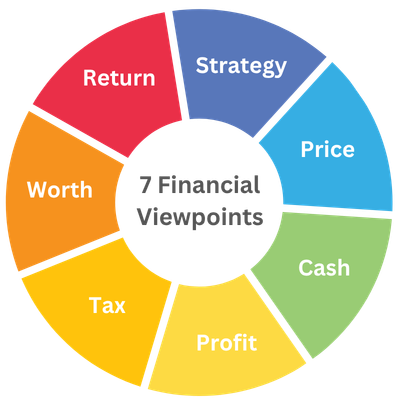 1. Strategy: Where Are We Going?
Your financial strategy connects what you want for the future with the resources you'll need to get there.
Maybe you want to hire three technicians, expand into another market, buy equipment, or build a company that operates without your daily involvement.
Before moving forward, you need to know whether the plan is financially attainable.
Questions to ask:
- What are we trying to accomplish?
- How much money will we need?
- Can our current operations support our plans?
- What needs to change before we move forward?
A good strategy helps you make decisions with the future in mind instead of simply reacting to what's happening today.
2. Price: Are We Charging Enough?
Your prices determine how much money customers contribute to your business.
You can generate cash by borrowing money, receiving investments from owners, or collecting payments from customers. But only customer-generated cash is a sustainable source for supporting ongoing operations over the long term.
That's why your prices matter so much.
Your price must do more than cover the obvious costs of providing a service.
It also needs to support overhead, future equipment needs, owner compensation, taxes, and a return for the risk of owning the business.
Questions to ask:
- Are our prices high enough to support the entire business?
- Do we know which services generate the most profit?
- Are we considering all the costs of delivering our services?
- Will our current prices support our future plans?
Your price is your financial plan. If your prices don't generate enough money, selling more may not solve your financial problems.
3. Cash: Where Did the Money Go?
Cash is the oxygen of your business. You may not think much about it until you don't have enough.
One of the most important lessons in business finance is this: Profit and cash are not the same.
Your company can report a profit while running short of money. For example, you may have completed a profitable job but haven't collected payment. Meanwhile, payroll, materials, and loan payments are due.
A cash flow statement helps you understand where money came from, where it went, and why your bank balance changed.
Questions to ask:
- How much cash do we really have available?
- Where did our money come from?
- Where did it go?
- Will we have enough cash to cover upcoming obligations?
When you understand how money flows through your company, you are better equipped to anticipate cash shortages before they become emergencies.
4. Profit: Are We Operating Profitably?
Profit tells you whether your company generates more revenue than the expenses required to operate it.
Your Profit and Loss Statement help you evaluate how efficiently your business operates. But the report must be prepared appropriately to give you meaningful information.
For example, an accrual-based management report can help match revenue with the expenses incurred to earn it, even when the cash moves at a different time.
Questions to ask:
- Are we delivering our services profitably?
- Are we controlling overhead?
- Are our profit margins improving or declining?
- Is our growth actually making the company stronger?
A profitable business has a better opportunity to build financial strength, but profit alone doesn't guarantee that cash will be available when you need it.
5. Tax: Are We Meeting Our Tax Obligations?
The tax viewpoint helps you understand your company's obligations under tax laws. It is essential for compliance and planning. But remember that taxable income is not the same as net profit or cash flow.
For example, money is needed to pay income taxes, but the payments may not qualify as a tax deduction. The company must consider income taxes as a cost of doing business when charging the right price, projecting cash flow and calculating profit.
Questions to ask:
- How much do we expect to owe in taxes?
- Are we setting aside enough cash?
- What tax planning opportunities are available?
- How will a tax-related decision affect the rest of the business?
Reducing taxes can be beneficial, but it shouldn't be your only financial goal. A purchase that saves taxes still requires money…that you may need during slow season.
6. Net Worth: What Do We Have to Show for Our Hard Work?
Your Balance Sheet provides a picture of your company's assets, liabilities, and equity.
Think about everything you've put into your business over the years. What do you have to show for it? More cash? More valuable equipment? Less debt? Greater ownership equity?
Questions to ask:
- Is our company becoming financially stronger?
- Are we building assets or accumulating debt?
- How much do we owe compared with what we own?
- Is the owner's equity increasing?
Your Balance Sheet helps you see whether your business is building financial strength over time.
7. Return: Is the Business Worth the Investment?
Owning a business requires an investment of money, time, and energy. It also involves risk.
The return viewpoint helps you evaluate what you're receiving in exchange for that investment in the form of a true equity distribution.
Salary pays you for your time. Equity distributions provide a return on the risk.
Questions to ask:
- Am I receiving a reasonable return for the risks I'm taking?
- Is the company creating value beyond paying me for my work?
- Could my money, time, and energy be used more effectively?
- Is the business becoming more valuable over time?
A financially successful business should create value for the owner, not just provide another job.
How the 7 Financial Viewpoints Work Together
These viewpoints aren't competing with one another. They work together to tell the complete financial story.
I like to think of the first three as foundational:
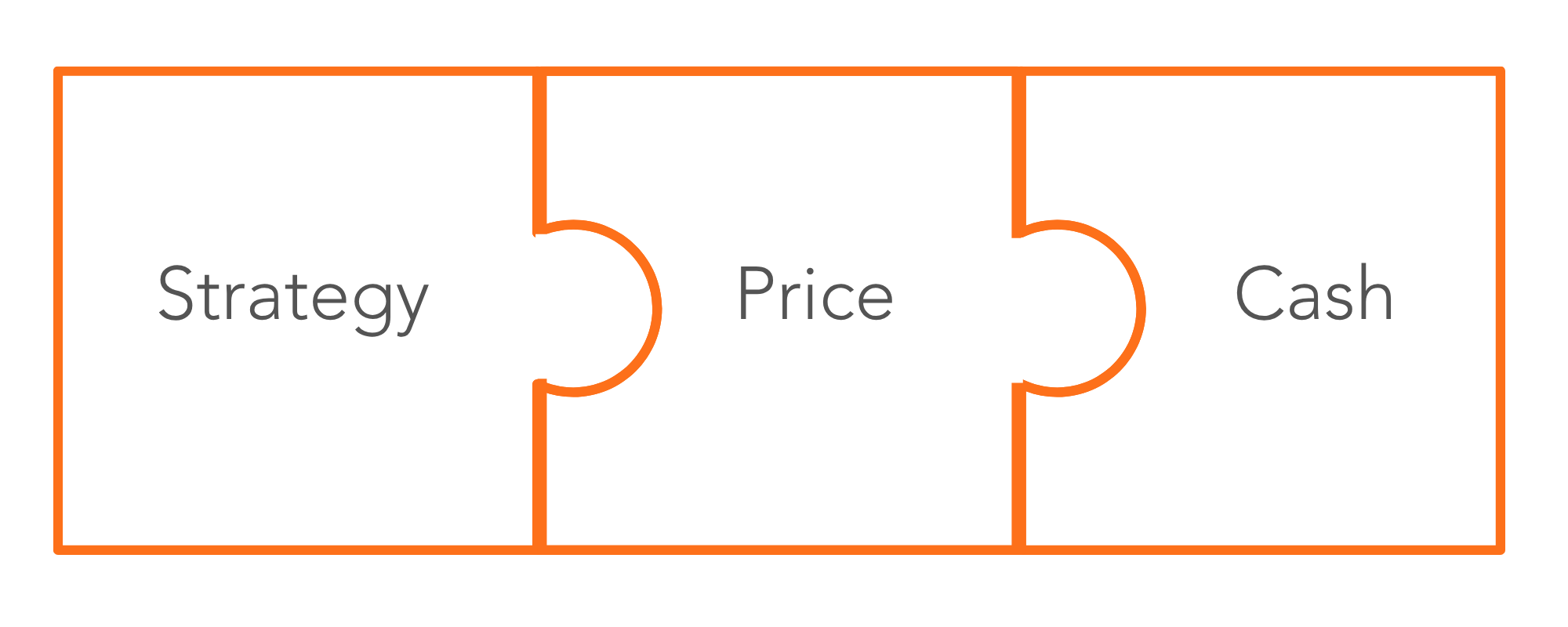
Your strategy establishes where you want to go.
Your prices help determine whether you can generate enough money to get there.
Your cash flow shows how money moves through the business and whether you have enough to keep operating.
The remaining 4 financial viewpoints are simply reporting formats of how cash flows through the business.
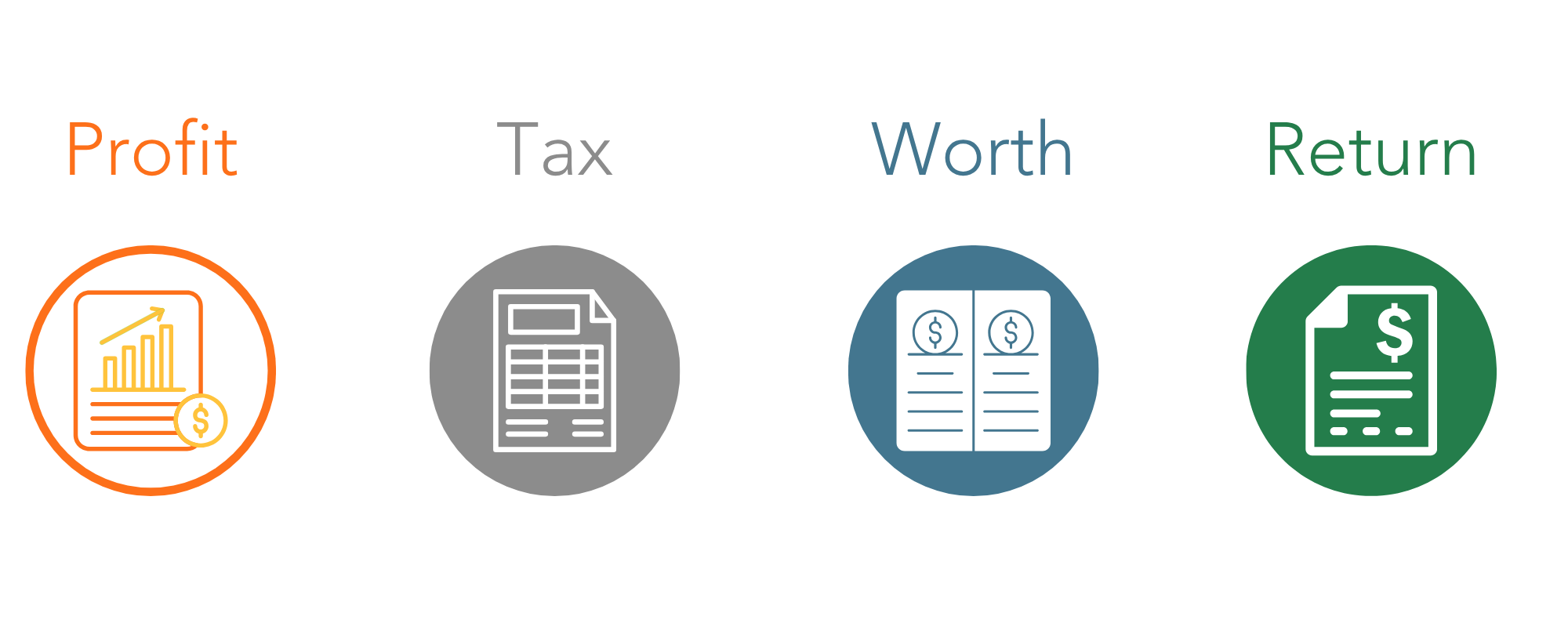
The costs that qualify as an expense show up on the profit and loss statement to calculate net income
The costs that are considered a tax deduction show up on the tax return to calculate taxable income
The costs that are considered assets show up on the balance sheet to calculate the net worth of the company
The costs that are considered a return on the owner’s investment are used to calculate the ROI of the risk the owner took.
These viewpoints are connected, but each answers a different question. You need the right viewpoint for the decision you're making.
Why Focusing Only on Taxes Can Lead to Bad Decisions
Taxes tend to get our attention because ignoring them can create expensive consequences. They're the squeaky wheel. But the loudest financial issue is rarely the most important one.
Income taxes are a cost of doing business and should not be considered a penalty for success.
Tax returns are designed for the IRS based on tax laws and it calculates taxable income. It helps you stay compliant with the tax authorities. Tax forms do not show you the true profitability of your company. That’s why Profit and Loss statements are so important. They show you true profitability. The goal is to match income and expenses in the right time period so profit is stabilized and tells the true story that is happening in your business.
Another reason it is dangerous to only look at the tax viewpoint is that it provides an incomplete picture of your finances. Depending on your tax structure, you can see very different numbers.
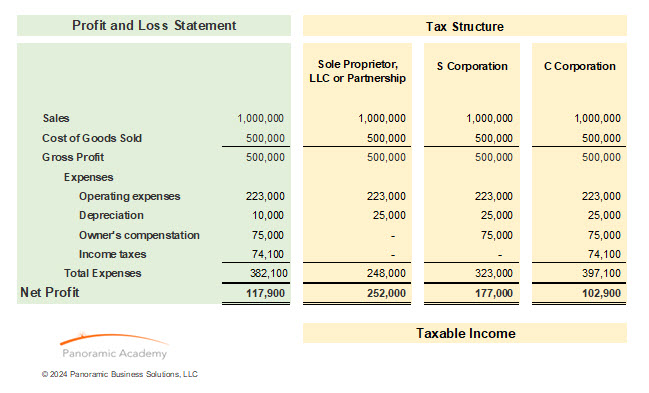
The tax treatment of depreciation, owner’s pay and income taxes are dependent on your tax structure.
Whether the expenses are tax deductible or not is irrelevant when calculating net profit. All three numbers are a cost of doing business.
All three affect cash flow and should be considered when you set your prices
As you can see from this illustration, the Profit and Loss Statement and the Tax Return are very different reports with very different purposes calculating very different numbers.
3 Ways to Stop Riding the Financial Rollercoaster
Rollercoasters are fun at an amusement park. They're not much fun when you're running a business. If you're tired of financial surprises, here are three practical steps you can take.
Step 1: Learn How Money Flows Through Your Business
Start by understanding where your money comes from, where it goes, and what's left.
You don't need complicated math to understand the basics.
You need to see the relationships between sales, expenses, debt, investments, and cash.
When you understand the flow of money, you can start identifying what's working, what's not, and what needs attention.
Step 2: Use the Right Viewpoint Before Making a Decision
Before making a major financial decision, ask yourself:
Which financial viewpoints do I need to consider?
If you're planning to hire another employee, look beyond whether you can afford the next paycheck.
Consider whether your prices will support the additional cost, how the hire affects cash flow, and whether the decision supports your long-term strategy.
Step 3: Make Sure Your Reports Help You Run the Business
Talk with your bookkeeper or accountant about the reports you use to make decisions.
Ask whether your Profit and Loss Statement is designed to show true profitability or primarily reflects tax reporting choices.
An accrual-based management report may give you a clearer view of operating performance.
You may also benefit from reports that show cash requirements, pricing performance, debt obligations, and owner’ return on the investment.
The goal isn't to produce more reports. The goal is to have the information you need to make better decisions.
The Bottom Line
Your business is more than a tax return, a Profit and Loss Statement, or a bank balance.
Each report tells part of the financial story.
When you rely on only one viewpoint, you risk making decisions without seeing how they affect the rest of your business.
But when you learn to look at your business through the right financial viewpoints, you can make decisions with greater confidence, anticipate problems, and build a financially stronger company.
Stop letting financial surprises determine your next move. Learn to see the whole money picture.
The goal isn't just to make more money. It's to build a business that knows how to make, manage, and keep enough money to support its future.
 CONTINUE LEARNING
Your Next Financial Surprise May Already Be Predictable
Understanding the seven financial viewpoints helps you see the whole money picture. The next step is recognizing expenses you can anticipate before they drain your bank account.
Read: Financial Surprises Are Predictable
Learn how to recognize the warning signs and make better financial decisions before problems catch you off guard.
Join the Community!
Learn the business skills you need
to grow a healthy, thriving business.
Wherever you are in your growth journey,
we’re here to help you get there
and avoid the potholes along the way.
Unsubscribe anytime.
